Spreadsheets built your business. You need a financial modelling platform to truly grow.
 Jess·January 15, 2026·5 min read
Why growing businesses are moving to a financial modelling platform
Every finance director we've spoken to started out on a spreadsheet, and most of them still have one open somewhere right now. They're quick, free, and flexible enough to cope with almost anything in the early stages of a business, which is exactly why so many SME finance teams still lean on them daily. In our latest survey of 170 finance professionals, 42% said they still model on spreadsheets alone.
That reliance comes at a cost. 45% say they lose significant time just updating the data in their models, 44% say checking those models for errors is a major drain, and a third (33%) name building what-if scenarios as one of their biggest challenges. Most can see where this is heading: 88% are very or extremely interested in moving to specialised modelling tools.
What we want to get into here is where that reliance on spreadsheets genuinely earns its keep, where it starts to strain as a business grows, and why financial planning in particular has outgrown a tool that was never built to carry it.
So where does that reliance earn its keep, where does it strain, and why has financial planning outgrown it?
Spreadsheets are genuinely brilliant for exploring an idea quickly. Testing a pricing scenario before a client call, pulling together a first draft budget, or sense checking a number someone's quoted you in a meeting are all things a spreadsheet handles well, mostly because it asks nothing of you and nearly everyone in finance already knows how to use one.
That's especially true for a small business where one person is doing the numbers and nothing serious rides on them beyond a quick gut check. A spreadsheet is often still the fastest route to an answer in that setting. The trouble tends to start when that same spreadsheet quietly gets promoted, without anyone really deciding it should be, into the model the whole business ends up planning around.
Where the wheels start to fall off
The problems rarely show up in the spreadsheet you built last week. They tend to surface in the one that's been passed between four people over two years, picking up a tab here, a workaround there, and a hardcoded number that made sense to somebody at some point but nobody can quite explain now.
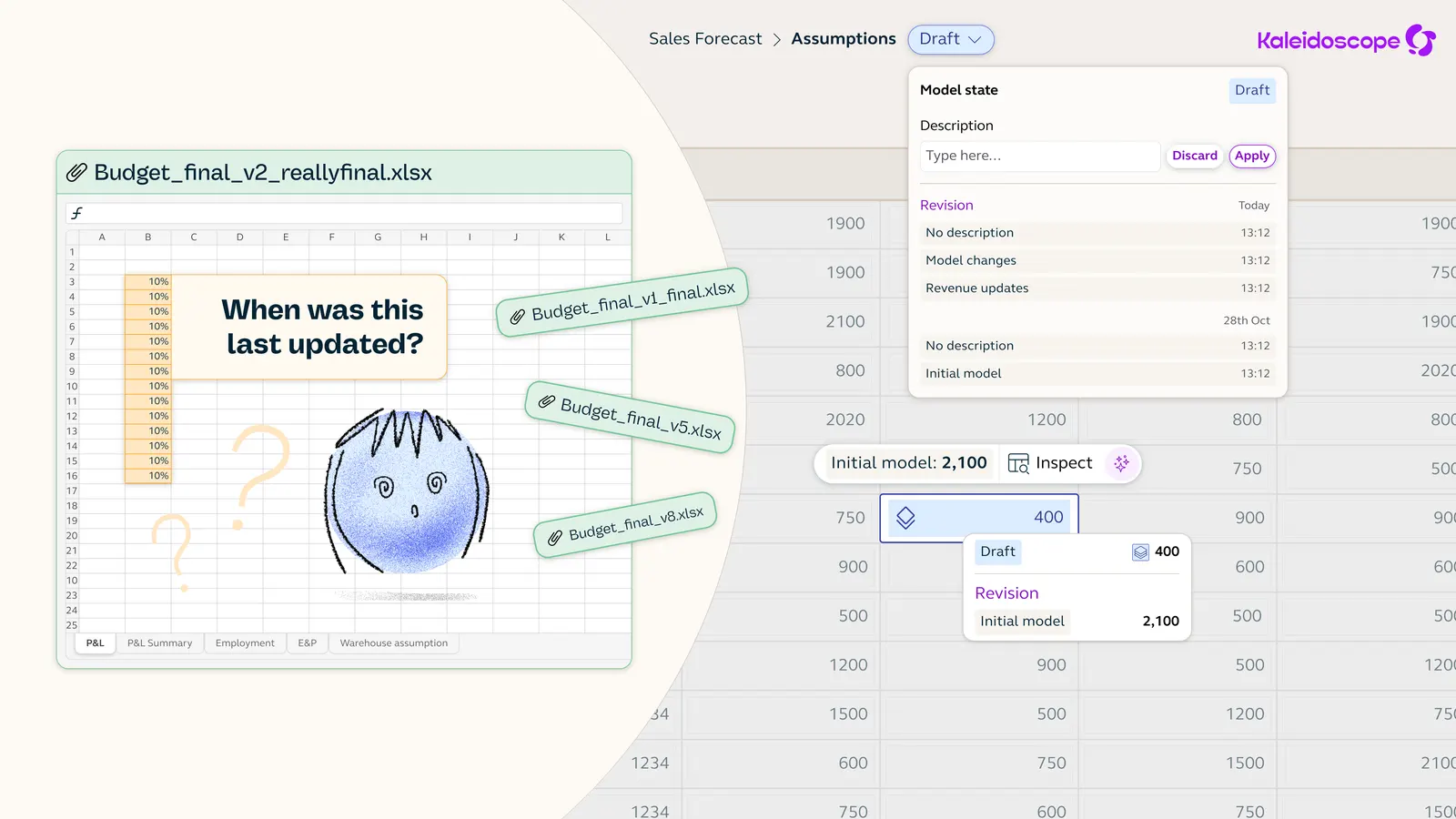
Version control is usually the first crack to appear. Anyone who's worked in finance for more than a few months will recognise the running joke of a file called something like Budget_final_v2_reallyfinal.xlsx, with several versions of the same model circulating by email and nobody entirely sure which one the number quoted in this morning's meeting actually came from.
Connecting to everything else is the next issue. A spreadsheet doesn't talk to your accounting software, your bank feed, or your CRM on its own, so someone has to re-key the numbers in by hand, and that means every model is really just a snapshot that's already going stale by the time anyone reviews it.
Then there's the error rate, which most finance teams tend to underestimate. A 2024 study published in Frontiers of Computer Science, led by Professor Pak-Lok Poon across four universities, found that 94% of business spreadsheets used in decision-making contain errors, largely because a spreadsheet has no built-in way to check itself.
On top of that sits the question of who can change what. There's no audit trail on a formula edit and no permissioning on who's allowed to touch the assumptions tab, which is how a junior associate reformatting a document in 2008 ended up exposing hidden rows that pulled 179 contracts into Barclays' acquisition of Lehman Brothers' assets the bank had never intended to include, and how a single formula dividing by a sum instead of an average sat inside JPMorgan's risk model long enough to contribute to $6.2 billion in trading losses. Those are extreme, headline-grabbing examples rather than a prediction for your own business, but the same mechanics play out in far smaller models every day, with nobody checking the formula and nobody able to see who last changed it.
Why it matters more as you grow
A spreadsheet one person manages is usually fine. A spreadsheet that five people edit, that feeds into board reporting, or that underpins a funding conversation or a hiring decision, carries a very different kind of risk. The more that rides on the number, the more a static, unverified model built by one person becomes something to worry about rather than something to lean on.
This is rarely anyone's fault individually, it's simply what happens when a tool designed for one person to think out loud ends up carrying decisions for an entire finance function, a shift nobody consciously chose but that accumulates gradually, tab by tab and workaround by workaround, until the model is too embedded to question.
Where spreadsheets and Kaleidoscope work together
We think the useful way to frame this is that spreadsheets still deserve a place in how you plan, just not as the system everything else depends on. They remain a good place to think, to test an assumption, or to sketch a scenario before it's ready for anyone else to see.
At Kaleidoscope, that's genuinely how we see them too. The numbers you've already built and the assumptions you've already tested can feed straight into a model that stays connected to your live data.
And you don't start from scratch. Kaleidoscope builds your model from the spreadsheets you already have, in minutes, with no blank template, no consultant and no implementation project. It keeps your financial models on one single foundation that you can trust, showing you exactly what changed, the part a spreadsheet was never built to do on its own.
It’s also why bringing AI into financial planning needs some care. Point an AI tool at a spreadsheet and it inherits every hidden row and unexplained hardcode, it just gets to the wrong answer faster. In Kaleidoscope, the AI works on top of an engine built on the rules of finance, so every assumption is traceable to where it came from, you can see exactly what the AI changed, and you stay in control of what goes into the model. And if you’d rather build by hand, you can. AI is one way in, not the only one.
If your forecast gets rebuilt from scratch every month, with everyone quietly hoping this is the version that's actually accurate, that's less a failing on the part of whoever's doing it and more a sign the spreadsheet has taken you as far as it reasonably can. At that point, it's worth having something built to keep going from where the spreadsheet stops.